
Most bettors know the phrase: “the house always wins.” But what if you’re the kind of bettor who’s smart enough to beat the house?
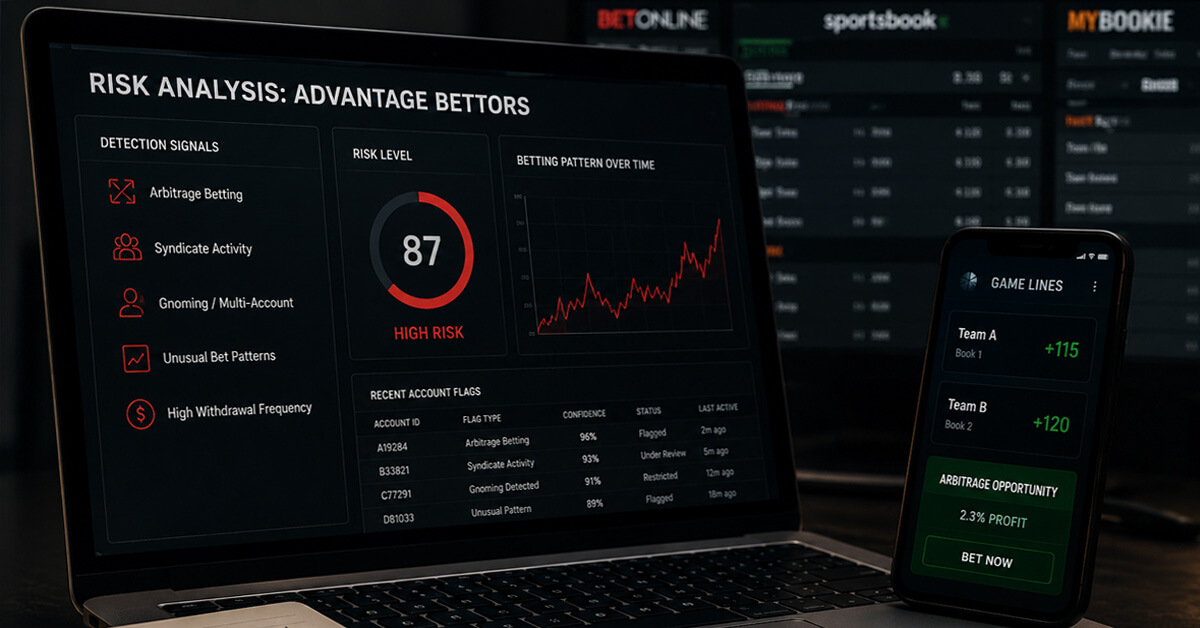
That’s where things get tricky. Because sportsbooks aren’t just tracking wins and losses anymore. They’re watching patterns, behaviors, and timing, and they’re using artificial intelligence to do it. Behind the user-friendly interfaces and flashy promos, there’s a machine learning system analyzing every bet you place.
If you’re an advantage player, someone who bets with purpose and edge, you might already be under the microscope.
What Is an Advantage Player (and Why Do Sportsbooks Care)?
Sportsbooks want winners, just not consistent ones. Not the ones who beat the line, grab mispriced odds, or find loopholes in promos. These are advantage players, and they don’t bet for fun. They bet to win. On purpose. With strategy.
Skill Over Emotion
Advantage players treat betting like a business. They’re not just hoping their favorite team covers. They’re:
- Watching line movement
- Tracking closing odds
- Betting only when the numbers make sense
Some have custom models. Some use scripts to speed up bets. Others grind soft markets, especially in less popular sports.
Whatever their method, they all share one trait: they don’t bet like the average player. And that’s exactly what triggers the sportsbooks’ AI.
Not All Sharps Are the Same
You’ve got solo bettors who live and breathe betting markets. Then there are syndicates—teams of bettors who coordinate wagers across multiple accounts. Some advantage players are arbers who lock in profits by betting both sides of a game at different books. Others are gnomers, using multiple accounts to avoid limits.
None of this is illegal. But it all costs the sportsbook money. That’s why many operators invest in systems designed to detect these strategies early, long before they start to impact the bottom line.
How AI Flags Unusual Betting Behavior
There’s no red alert when you place a sharp bet. But the moment you step outside the norm, the AI notices.
Sportsbooks today use advanced algorithms that learn what typical betting looks like. The AI doesn’t just flag rule-breakers. It flags anything that doesn’t fit the mold.
Tracking in Real Time
Every sportsbook interaction is tracked and logged:
- Bet amount
- Event type
- Time of day
- Device used
- Odds at the moment of the bet
Machine learning tools are trained on thousands of these data points. They build profiles. And when you start betting like a pro, whether it’s grabbing early lines, avoiding juice, or sniping off-market odds, the system takes note.
It’s not just about what you bet. It’s about how you bet.
Anomalies Get Flagged Instantly
Old fraud tools used rigid rules. Today’s AI watches trends. If your pattern suddenly changes, like jumping from $20 NFL sides to $500 bets on obscure tennis matches, the AI sees that jump and flags it as an anomaly.
That flag might trigger a limit on your next bet. Or it might escalate to a full review. Either way, you’re no longer just another bettor.
The Types of Advantage Players That AI Catches the Most
Not all sharp bettors look the same. Some hunt for pricing mistakes. Others work in groups. Some try to stretch their betting lifespan by running multiple accounts. And sportsbooks train AI systems to spot them all.
Wins and losses. Behavior. Timing. Bet sizing. Device data. Patterns across thousands of wagers. AI is tracking all of it these days. And over time, certain types of advantage players become easy to identify.
Arbitrage Bettors
Arbitrage betting, often called “arbing,” is one of the oldest advantage strategies out there. It works by betting all outcomes of a game at different sportsbooks to lock in a guaranteed profit from odds discrepancies.
Sounds smart. But sportsbooks hate it. And AI is very good at finding arbers.
Over time, the same patterns keep showing up:
- Frequent identical bet sizes
- Perfectly hedged wagers on both sides
- Steady, low-variance profits
- Fast bets immediately after odds shifts
- Heavy action on obscure markets instead of popular games
- Betting activity during off-peak hours
AI systems compare this behavior against normal recreational bettors. Once an account starts looking too calculated or too consistent, it may get flagged, limited, or closed.
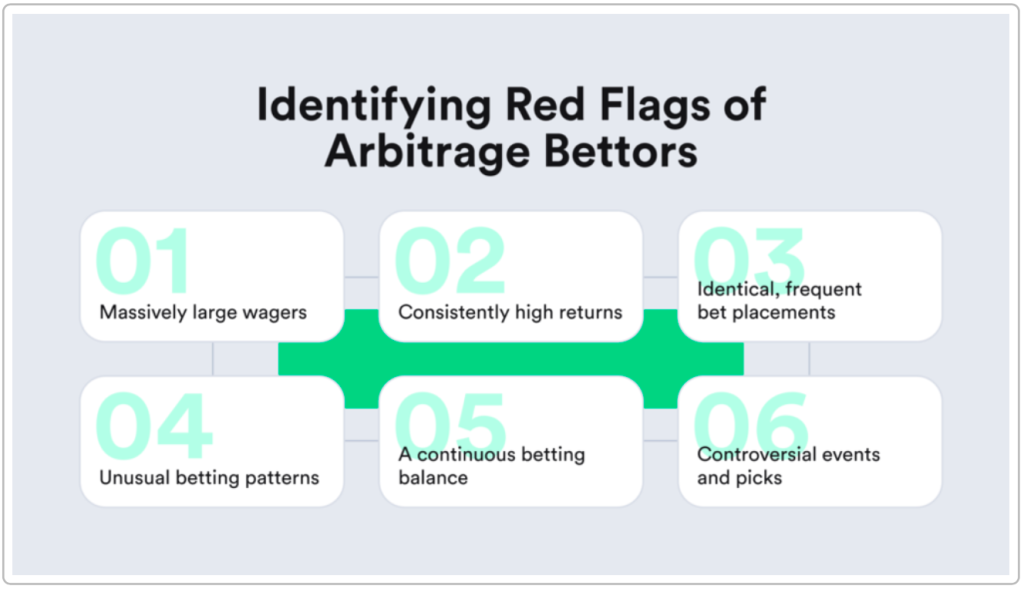
Figure: An example infographic highlighting red flags of arbitrage bettors. AI systems look for telltale signs like unusually large or repeated identical wagers, consistently high returns with minimal losses, a continuously steady account balance, and bets on obscure or “controversial” events
Syndicates
Some sharp bettors don’t work alone. Syndicates are coordinated groups that spread bets across multiple accounts to maximize volume and avoid drawing attention.
Sometimes they hammer the same number at once to move a line. Other times they split large wagers across several accounts to stay under betting limits.
The AI looks for coordinated behavior like:
- Multiple accounts placing the same obscure prop at the same time
- Sudden bursts of betting activity across linked accounts
- Large wagers split into smaller synchronized bets
- Accounts with nearly identical betting histories
- Coordinated action immediately after line movement
Sportsbooks also use graph analysis tools to connect related accounts through betting behavior, devices, IP addresses, and payment methods.
Gnomers
Gnoming happens when one bettor operates multiple accounts under different names. Usually it starts after an account gets limited. The bettor opens another account using a friend’s identity, a family member’s information, or a burner phone number.
AI systems track much more than usernames. They compare behavior across accounts and look for overlap that casual users wouldn’t normally have.
Common gnoming red flags include:
- Shared devices or IP addresses
- Matching login times and betting habits
- Similar deposit and withdrawal patterns
- Repeated betting on the same niche markets
- Accounts showing overlapping behavior over time
Once linked, these accounts are often frozen, limited, or sent through additional identity verification checks.
The Tech Behind the Curtain
So what’s actually powering all of this?
It’s not one tool. It’s a full stack of technologies working together in real-time.
A Multi-Layered System
- Neural networks process massive amounts of historical betting data to spot patterns
- Anomaly detection algorithms flag bets that fall outside the norm
- Supervised learning models assign risk scores to new accounts based on known sharp behavior
- Graph-based systems map relationships between users, devices, and behaviors
Every sportsbook click, whether it’s a login, a deposit, or a bet, is run through these systems.
Some sportsbooks even run streaming models that analyze data in milliseconds. If a coordinated attack or arbitrage move is in progress, the system can auto-limit bets before a human even gets involved.
Where Ethics and AI Collide
The idea that AI is watching your bets may feel invasive. And you’re not wrong. The systems work in the background. You don’t see them. You don’t opt in. And you rarely get to appeal.
Privacy, Fairness, and False Positives
AI models operate in a black box. If you’re flagged, you probably won’t be told why. And there’s always a risk of false positives. You can get limited for not even being sharp if your profile feels sharp.
This raises serious ethical concerns:
- Are sportsbooks punishing people for simply being good?
- Are they transparent about what data they collect?
- What protections do bettors have against wrongful flagging?
The answers vary by operator. Some involve human reviewers. Others don’t.
The Bigger Picture
AI can help spot fraud, stop bots, and even detect problem gambling. But when it’s used too aggressively, it can create a market where winning bettors, even legitimate ones, end up getting boxed out.
That’s not good for the game. And it’s not good for trust.
Remember That AI Is the New Line Judge
Sportsbooks used to rely on gut instincts and basic rules. Now, they rely on code. And that code gets smarter with every bet placed.
If you’re a sharp bettor, this is the landscape now. You’re not just trying to beat the line; you’re also trying to avoid being flagged by a system that doesn’t miss much.
AI isn’t your enemy. But it’s definitely not your friend in this scenario. It’s just doing its job. And that job is to protect the book.
So yeah, the house still wins. But now it wins with help from machines that never blink.
About the Author

Alonzo Solano
The Boss of Betting, Editor-in-Chief & Sports Analyst
Alonzo Solano is an author, sports analyst, Editor in Chief of BossofBetting.com, and host of the 'NFL Latino TV' podcast.
Outside of family, his biggest passion is NFL football. Perhaps he is best known for his podcast 'NFL Latino TV,' where he shares his analysis and perspectives on the game with a worldwide Spanish-speaking audience.
Previous post

Why Some Bettors Are Avoiding Mainstream Events for Niche Sports Betting
Alonzo Solano | May 23, 2025Next post