
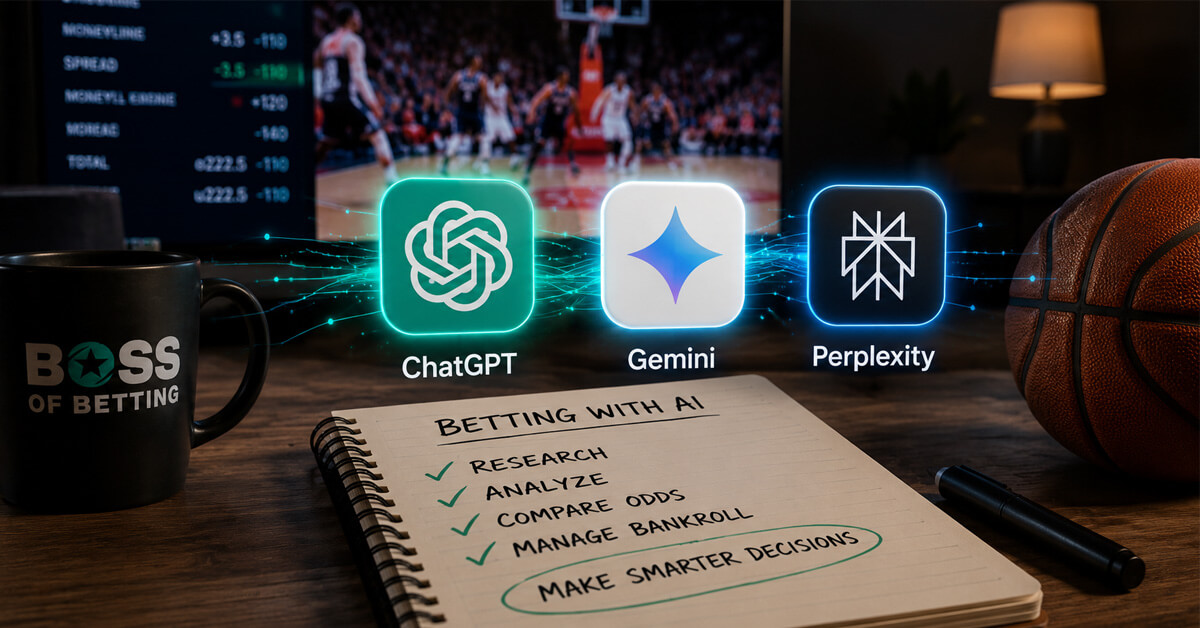
Can AI help you bet on sports? It can, but not in the way most bettors hope. AI speeds up research, organizes stats, and handles calculations most bettors skip, yet it won’t convert uncertain outcomes into reliable profit or fix a broken betting process. The gap between genuine utility and inflated expectation is exactly where bankrolls get damaged.
That gap between convenience and actual edge creates most of the confusion. A bettor opens ChatGPT, asks for an NBA pick, gets a polished answer, then asks again after an injury update and receives a different angle. The tool looks smart, but its real value isn’t prediction. It’s fast organization, clearer thinking, and quicker verification when used carefully.
Sports betting AI appears everywhere now, from general chat tools to paid pick services wrapped in machine-learning language. Some products promise hidden edges and massive accuracy. In practice, useful tools typically handle simpler jobs well: summarizing information, checking sources, comparing prices, and helping you think in probabilities rather than opinions.
This article focuses on practical applications of AI betting tools, including ChatGPT sports betting use cases, Gemini, and Perplexity. The goal is straightforward: show where AI helps, where it misleads, and how to use it without surrendering decision-making to a machine that doesn’t risk its own money.
Here’s what this article covers:
- The difference between general AI tools and specialized betting platforms
- What ChatGPT, Gemini, and Perplexity can realistically do for bettors
- Practical ways to use AI for research, pricing, and bankroll management
- The biggest risks of relying on AI betting assistants
- Simple workflows for testing whether AI improves your results
Understanding What AI Can and Cannot Do for Sports Betting
AI helps most when you understand its actual job. In sports betting, that job involves pattern recognition, information retrieval, and organization, not true foresight. AI sports analysis looks impressive because it processes information quickly, and that speed matters.
Feed a tool team stats, pace data, injury reports, and market odds, and it pulls everything into a readable summary in seconds while highlighting relationships worth checking.
That speed doesn’t make it predictive in the way many bettors assume. Most general AI tools don’t “know” a game the way a purpose-built betting model tries to know one. They generate answers from training data, tool access, prompt context, and current web information when browsing is available. The output can sound sharp while remaining incomplete, stale, or too broad.
Correlation vs Causation
One important distinction involves correlation versus causation. AI finds that a team has covered after double-digit losses, or that a pitcher has better daytime splits.
That doesn’t mean those patterns caused the results or will continue once the market adjusts. It’s also worth separating general language models from specialized predictive systems. Purpose-built models can sometimes predict sports outcomes better than chance in controlled settings, but that’s different from beating betting markets after vig, line movement, and price efficiency enter the picture. Predicting winners and finding positive expected value aren’t the same skill.
What Tools Do Well
In practical terms, ChatGPT summarizes the last 10 games for two NBA teams, Gemini surfaces recent news and lineup context, and Perplexity points you to current sources and makes verification easier. Those tasks are genuinely useful. None of them guarantee a bet worth making.
AI handles certain betting workflow tasks well, including organizing large amounts of information, explaining betting concepts and formulas, summarizing trends and matchup notes, converting odds into implied probabilities, and comparing arguments for and against a wager.
The Not So Strong Skills
AI struggles with late-breaking uncertainty when verified data is missing, has trouble separating sharp signal from noisy trend-chasing, can’t price markets with consistent accuracy, misses human factors that never show up cleanly in data, and rarely acknowledges when the smartest move is no bet at all. Sports remain human, messy, and unstable, which is exactly why AI can support your process without becoming your decision-maker.
The most important part of using AI for sports betting is knowing where it breaks down. These limits apply to general tools like ChatGPT and Gemini, and they apply to specialized betting platforms too.
- Human variables: AI can’t reliably predict late injury setbacks, locker-room issues, motivation swings, or coaching choices that change a rotation. A team looks like value all afternoon, then loses its edge when a trusted beat writer reports a minutes restriction shortly before tip.
- Live momentum swings: Games change faster than most AI tools can interpret. Two early fouls on a point guard, a bench unit catching fire, or a first-quarter injury can wreck a pregame angle immediately.
- Rapid weather changes: Weather feeds exist, but outdoor sports change fast. Wind, rain, humidity, field conditions, and delays shift scoring environments quickly in football and baseball.
- Referee variance: Officials influence pace, foul rates, and game flow, but that influence stays inconsistent. Historical ref tendencies provide context, not certainty.
- Pressure responses: AI can point to past performance in high-leverage spots, but it can’t measure confidence, panic, or how a player responds to a specific moment.
- Market adjustment speed: Even when a real edge appears, it often disappears quickly. If enough bettors find the same soft prop or stale side, the book moves the number or limits action.
Keep those limits in view and AI becomes easier to use responsibly. Ignore them and AI turns into a polished way to justify bad bets.
ChatGPT, Gemini, and Perplexity: A Realistic Assessment for Bettors
These three general AI tools come up constantly in sports betting conversations because they’re easy to access and flexible enough to adapt to betting research. They can all help, and they can also mislead if you expect them to act like proven betting models.
ChatGPT for Sports Betting

ChatGPT works best as a flexible research assistant. It’s especially useful when you want to turn messy notes into a clean framework, understand betting math, or think through how a lineup change affects your view. Its biggest advantage is ease of use. You can ask layered follow-up questions, refine the prompt, and have it explain concepts clearly. Its biggest weakness is freshness. Depending on the plan, settings, and tools available, it may lack reliable access to current injuries, line moves, or breaking news. Features and pricing change over time, so confirm what your version actually does before relying on it.
ChatGPT adds real value in a few specific areas. It handles implied probability, expected value, Kelly staking, and bankroll basics in plain language. Paste in stats, injury notes, or game logs and it turns them into a usable summary quickly. It’s also good for conditional thinking, such as asking how your view should change if a starter sits, if pace drops, or if a spread moves. Beyond that, it cleans up rough betting journals, structures matchup notes, and handles stake sizing, ROI math, and simple probability calculations without much effort.
Where it hurts you is just as predictable. Assume it knows today’s injuries or depth chart changes and you’re betting into stale information. It may also invent stats or matchup history while sounding fully certain, and when sources aren’t clearly visible, you end up trusting claims you can’t verify. Ask for a winner and you typically get a polished answer even when pricing context is missing, and it can stitch together a convincing case from too many weak trends, making a bad angle look disciplined.
Google Gemini’s Strengths and Weaknesses

Gemini proves strongest when current information matters most. It tends to be more useful than a closed model when you need recent news, lineup updates, and quick source cross-checking tied to Google’s search ecosystem. That makes Gemini practical for bettors who care more about freshness than elegant phrasing. Like every AI betting assistant, it still needs verification. A clean summary of a weak source remains weak information.
Gemini earns its place in a betting workflow through a few specific strengths. It often surfaces recent reporting on injuries, starters, and team context more reliably than models working from memory. It helps compare what national outlets, beat writers, and public stats pages are saying, and it works well for quick overviews of travel, rest, schedule, and recent form. If you already manage research in Google products, Gemini slots into that process without friction.
Its weaknesses are worth knowing before you rely on it. Gemini can flatten nuance and misread the importance of words like “probable,” “questionable,” and “game-time decision.” Search access doesn’t guarantee good sources, and it still leans on weak articles or rumor-driven pages at times. It may also find the news without explaining whether the market already priced it correctly, and not every headline deserves a betting reaction, which Gemini doesn’t always make clear.
Perplexity AI: The Research-Focused Option

Perplexity is typically the easiest of the three for verification. Its research-first style and visible sourcing make it well suited to bettors who want to trace claims before trusting them. When checking injury news, lineup changes, or a report making rounds on social media, being able to click through to the source matters. Perplexity is less useful as a pricing engine and more useful as a verification layer.
Its strengths center on transparency and current research. You can see where information came from and judge whether the source deserves trust. It pulls together recent reports, lineup news, and weather context in one place, and you can start broad and narrow the question without losing the thread. It’s also effective at checking whether a betting narrative is backed by real reporting and at comparing conflicting local and national coverage.
On the downside, if available articles are sloppy, the summary will still be sloppy. Perplexity tells you what changed without telling you whether the current number still has value. It’s better at research than deeper betting math or model-driven reasoning, and too many sources can slow you down when a number is moving. It also doesn’t replace odds screens, line-shopping tools, or real-time sportsbook tracking.
ChatGPT vs. Gemini vs. Perplexity: Feature Comparison
| Feature | ChatGPT | Gemini | Perplexity |
|---|---|---|---|
| Real-Time Data Access | Often limited unless your version includes browsing or connected tools. Base answers may rely on older information. | Stronger access to current web information through Google Search, though summaries can still miss nuance. | Strong current web access with cited links, useful for checking recent reports and injury news. |
| Source Transparency | Often weaker unless sources are shown or requested directly. | Moderate transparency depending on response format and linked results. | Usually the strongest of the three for visible sourcing and source tracing. |
| Ease of Use | Very easy for conversation, note organization, and betting math. | Easy to use, especially for bettors already inside Google’s ecosystem. | Easy enough, but more research-oriented than conversational. |
| Best Use Case for Betting | Explaining concepts, organizing notes, summarizing stats you provide, and handling bankroll math. | Finding recent team news, current public stats, lineup updates, and fast source comparison. | Verifying sources, checking current reports, and tracing news-driven angles before betting. |
| Biggest Limitation | Can sound convincing while using stale or incorrect information. | Can oversimplify sources and offer shallow betting interpretation. | Good for research, not especially good at pricing a market. |
| Cost | Free tier available. Paid access has often been around $20 per month, but plans and features can change. | Free tier available. Advanced access has often been tied to Google One AI Premium, but pricing and features can change. | Free tier available. Pro access has often been around $20 per month, but pricing can change. |
How AI Tools Can Actually Help Without Losing You Money
AI adds the most value when you treat it like a research assistant, not a digital handicapper. The right mindset is simple: let AI save time, organize information, and test your assumptions, but keep verification and final judgment in human hands.
Research and Information Gathering
This is the cleanest use case for AI in sports betting. The tools are fast, and speed matters when sorting stats, injury context, and matchup notes across multiple games.
Compile recent team data: Ask AI to summarize only the stats that matter to the market you want to bet.
Example prompt: “Summarize the last 10 games for the Knicks and Heat, including offensive rating, defensive rating, pace, rebounding, and ATS record.” Then verify key numbers against a trusted stats source.
Summarize injury news: AI pulls together public injury information faster than most manual searches.
Example prompt: “Summarize the latest injury report for tonight’s Lakers game and explain how each questionable player could affect rotation minutes.” Use that summary to build a verification checklist, not to place the bet immediately.
Review head-to-head context: Matchup history provides useful background if you keep it in perspective.
Example prompt: “Give me the last five Celtics-Bucks meetings with final scores, pace, and major lineup differences.” Use it for context, not as a stand-alone reason to bet.
Explain line movement: AI helps you think through why a number moved and whether that move likely reflects real information.
Example prompt: “The spread moved from -3.5 to -5. What are the likely reasons for that move in this matchup?” That helps you decide whether value remains or the edge is already gone.
Find overlooked news angles: Travel issues, coach comments, bullpen usage, and weather updates often matter more than broad narratives.
Example prompt: “Find current news that could affect tonight’s Dodgers game, including bullpen usage, weather, and lineup notes.” Then confirm the most important items with direct sources.
Tip: Always verify AI-provided stats before you bet. If a tool says a team is 7-3 ATS in its last 10, check a trusted source before risking real money.
Identifying Value Bets and Line Shopping
AI helps with price comparison and probability math, which makes it useful for value-focused betting. It doesn’t find automatic profit, but it does help you get to the pricing question faster. The four prompts below cover the most practical applications.
Implied probability math: Ask AI to convert odds into implied probabilities and compare them to your own estimate.
Example prompt: “Convert +140, +155, and +165 into implied probabilities and show which price offers the best theoretical value.”
Multi-book line comparison: If you provide the odds, AI organizes them into a clean ranking.
Example prompt: “Compare these five moneyline prices for the same game and rank them from best to worst for a bettor backing the underdog.”
Line movement summaries: AI helps explain whether movement reflects injury news, market sentiment, or a broad correction.
Example prompt: “Track the movement from open to current odds on this NFL spread and summarize likely reasons for each major move.”
Arbitrage math: With the right inputs, AI quickly calculates whether a small arbitrage window exists and what stake split it would require.
Example prompt: “Using these odds from four sportsbooks, check whether an arbitrage opportunity exists and show the stake split.”
Repeated line shopping is one of the few edges ordinary bettors actually control. Finding +165 instead of +155 won’t feel dramatic on one bet, but that difference matters over time. Using a no-vig calculator to strip out the bookmaker margin makes it much easier to compare true prices across books and identify where genuine value sits.
Analyzing Trends and Patterns
AI surfaces trends quickly, which is helpful for narrowing your research. It becomes dangerous when you treat every pattern like a signal worth betting. The prompts below give you a structured way to use trend analysis without over-relying on it.
ATS trend review: AI summarizes recent against-the-spread performance and splits it by role and venue.
Example prompt: “Show Team A’s ATS results in the last 20 games, split by home and away.”
Rest and schedule spots: AI highlights back-to-backs, travel disadvantages, and dense scheduling clusters.
Example prompt: “Analyze both teams’ rest, travel, and schedule difficulty entering tonight’s game.”
Divisional or conference patterns: Familiar opponents produce different styles and tighter rotations.
Example prompt: “Compare this NFL team’s scoring and ATS record in divisional games versus non-divisional games over the last two seasons.”
Warning: Trends age badly. A useful pattern stops mattering as soon as the market prices it correctly, the roster changes, or variance swings the other way.
Bankroll Management and Risk Assessment
Bankroll work is one of the safest and most useful roles for AI. The math is clearer, the inputs are more stable, and the risk of invented narrative is lower. These four prompts cover the most practical applications.
Calculate Kelly stakes: Determine a suggested bet size based on the math of the Kelly Criterion formula. Use the result as a ceiling, not as permission to bet aggressively.
Example prompt: “My bankroll is $1,000, the odds are +120, and I estimate a 48 percent chance to win. Calculate full Kelly, half Kelly, and quarter Kelly.”
Spot tilt patterns: If you see a pattern here, you have a process problem, not a pick problem.
Example prompt: “Analyze this betting log and identify whether my bet size increases after two consecutive losses.”
Estimate variance: This helps you separate normal variance from real deterioration.
Example prompt: “Based on a 55 percent win rate at -110 over 200 bets, what losing streaks should I expect?”
Create stop-loss rules: Clear rules protect you better than vague promises to stay disciplined.
Example prompt: “Create stop-loss rules for a $2,000 bankroll using 2 percent max risk per play and a 6 percent daily cap.”
The Dangerous Ways AI Can Hurt Your Betting and How to Avoid Them
The biggest risk with AI isn’t that it’s obviously bad. The risk is that it often feels smart enough to trust when it hasn’t earned that trust. Most AI-related betting mistakes come from misplaced confidence, weak verification, and bettors outsourcing judgment because the answer sounds polished.
Treating AI Predictions as Expert Picks
The most common mistake is also the simplest: asking an AI tool who will win and betting the answer. That’s not analysis. It’s a shortcut disguised as analysis. General AI models are built to produce plausible responses, not to beat betting markets consistently. A clean, confident write-up makes a weak pick feel more credible than it is.
To avoid that trap, change how you prompt. Ask for factors rather than winners: “What factors matter most in this matchup at -3.5?” Force price sensitivity: “At what number would this underdog stop offering value?” Request the bear case: “Give me three reasons this wager could be a bad bet.” Use AI to frame the research, then verify the facts and make the final decision yourself.
Ignoring Data Freshness and Accuracy Issues
Bad betting information often arrives wrapped in confident language, which is especially dangerous when lineups, injuries, weather, and line movement can change the true price of a bet in minutes. One wrong detail turns a decent angle into a bad wager. A tool may summarize last season’s split instead of this season’s, miss a lineup change, or pull an injury note that’s no longer current. Use this checklist every time:
- Check official injury reports: Confirm player status through league reports, team releases, or trusted injury trackers.
- Verify the season and sample: Make sure the stats match the correct year, roster, and time window.
- Confirm expected lineups: Projected starters aren’t the same as confirmed lineups.
- Recheck market prices: Even if the information is right, the number may already be gone.
Over-Complicating Your Analysis With AI
AI makes it easy to build an impressive amount of analysis around a very small edge. That volume feels like discipline when it’s really just noise. A bloated case built from 15 weak trends is still a weak case, and more information only helps if it meaningfully changes your estimate.
To stay grounded, limit the core variables. For an NBA total, pace, efficiency, injuries, and rest typically matter more than a long list of novelty trends. Give AI a narrow prompt so it works inside your framework instead of inventing one. If several stats tell the same story, count them once. And remember that a complete analysis ending with no bet is still useful analysis.
Chasing Losses With AI-Generated Systems
Losses create urgency, and urgency makes bad AI use more likely. After a rough run, bettors often ask AI to build a system that will win it back. The result typically looks structured enough to feel trustworthy, but AI produces a convincing set of filters from noisy historical data. A system that looks scientific is still just another chase strategy if its real purpose is recovery.
Protect yourself with clear rules. Set hard loss caps and stop for the day or week when you hit a pre-set bankroll threshold. Don’t use any AI-generated strategy live until you’ve paper-tracked it for a meaningful sample. After a bad day, step away before asking for more angles. Write down the reason for every bet, and if the reason is to get even, the bet shouldn’t happen.
Misunderstanding Probability and Variance
AI presents numbers with a level of confidence that feels precise, and bettors often mistake that presentation for certainty. A strong favorite still loses often enough to punish sloppy staking. Even a real 55 percent edge produces ugly short-term losing streaks. A good week doesn’t confirm your process, and a bad week doesn’t automatically disprove it. Probability also isn’t value without price. A team can be likely to win and still be a bad bet if the odds are too expensive.
If AI helps you do anything, it should help you think in probabilities, pricing, and sample size. If it makes you feel more certain than the data deserves, it’s working against you.
General AI vs. Specialized Betting Platforms
General AI tools and specialized betting platforms solve different problems. One is flexible, broad, and relatively cheap. The other is typically narrower, more betting-specific, and built around market execution. Understanding which fits your situation saves you money and keeps your process cleaner.
General Tools
General AI tools win on flexibility. They’re useful when you need explanations, note organization, idea testing, and broad research across several topics.
They carry a lower cost, with free tiers or modest monthly subscriptions that are easier to justify for casual bettors. They cover injuries, schedules, weather, odds math, and betting education in one place, which makes them especially good for bettors still learning expected value, closing line value, or bankroll management.
General AI makes the most sense for beginners, lower-volume bettors, and anyone building a process before paying for additional software.
If you’re still evaluating where to place your bets, reviewing the top-rated sportsbooks available to you is a practical starting point before layering in any AI-assisted research workflow.
Specialized Platforms
Specialized platforms are built around betting tasks first. When well designed, they offer tools general AI can’t reliably match, particularly around speed, structure, and market execution.
They’re built to monitor books and price changes faster than general chat tools, and some include structured projections for spreads, totals, or props.
Good platforms make line shopping, stale number detection, and process quality measurement much easier, while arbitrage scanners, value alerts, and prop finders reduce manual work for bettors placing high volume across books and sports.
That doesn’t mean every specialized platform is worth the subscription. Before paying, look for transparency, reliable data sources, clear methodology, and evidence that the product helps you beat prices rather than simply consume more content.
Choosing the Right Tool for Your Betting Profile
- Beginner Bettor under 6 months of experience: General AI tools only. Your priority is learning pricing, bankroll management, and research habits without adding unnecessary software costs.
- Casual Bettor with bankroll under $500: Mostly general AI tools, or no paid tools at all. A small bankroll makes subscription costs harder to justify. Focus on line shopping and discipline first.
- Regular Bettor with bankroll from $500 to $2,000: General AI plus selective specialized tools if volume is high enough. You may benefit from odds tracking or prop tools, but only if your betting frequency makes the cost reasonable.
- Serious Bettor with bankroll above $2,000: Combination of general AI research and specialized betting platforms. At higher volume, market speed, line capture, and structured tools matter more.
- Research-Focused Bettor: General AI first, specialized tools optional. If you prefer building and verifying your own angles, general AI gives you the flexibility to do that.
- System-Focused Bettor: Specialized platforms with general AI for supplemental research. System bettors benefit from structured tracking, model outputs, and execution tools that general AI doesn’t provide. Pairing those tools with proven sports betting strategy frameworks gives your system a more disciplined foundation.
ChatGPT, Gemini, and Perplexity each earn a place in a betting workflow, but only when matched to the right task: Gemini for freshness, Perplexity for source verification, ChatGPT for math and organization. None of them replace closing line value discipline or sharp bankroll rules. If you want to put these tools to work immediately, exploring how to build a structured line-shopping process is the logical next step.
About the Author

Alonzo Solano
The Boss of Betting, Editor-in-Chief & Sports Analyst
Alonzo Solano is an author, sports analyst, Editor in Chief of BossofBetting.com, and host of the 'NFL Latino TV' podcast.
Outside of family, his biggest passion is NFL football. Perhaps he is best known for his podcast 'NFL Latino TV,' where he shares his analysis and perspectives on the game with a worldwide Spanish-speaking audience.
Previous post
How Sportsbooks Use AI to Detect Advantage Players
Alonzo Solano | May 21, 2026Next post