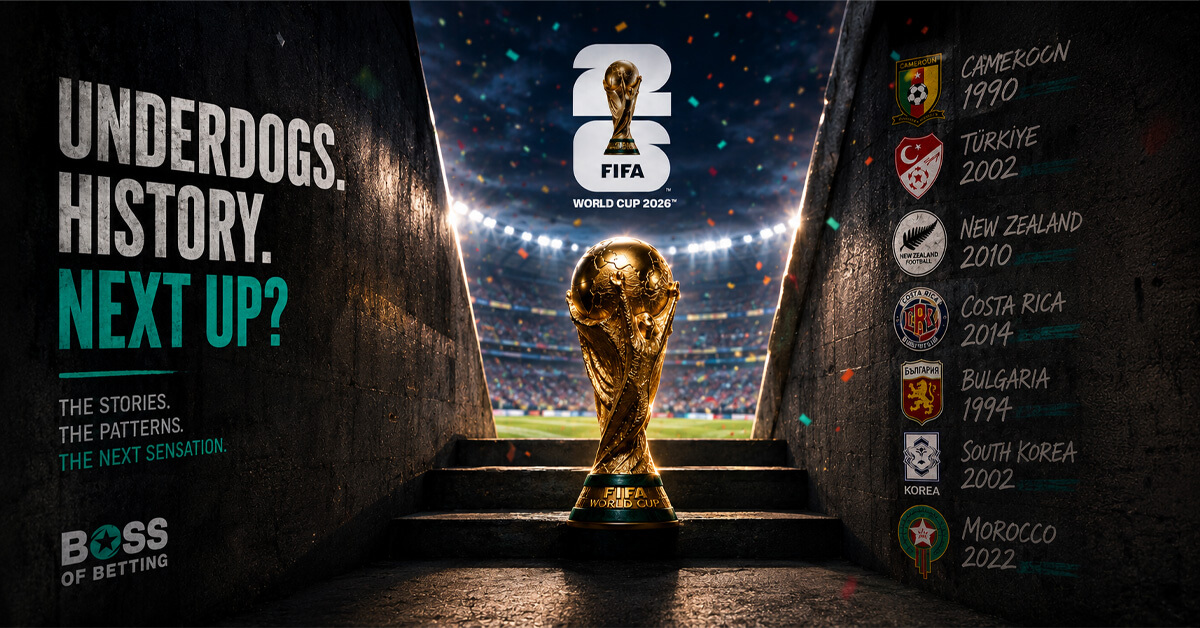
Morocco’s path to the 2022 semifinals proved once again what sets the men’s World Cup apart. A team nobody expected to advance past the group stage ended up defeating Spain and Portugal while carrying the dreams of an entire continent. These underdog stories stick with us because they transcend the scorelines.
Qatar wasn’t an anomaly. The World Cup has always made space for rebellion. North Korea stunned everyone by reaching the 1966 quarterfinals, and Costa Rica shocked the football establishment in 2014. These aren’t flukes. Deep outsider runs often follow specific patterns.
This makes predicting the next giant-killer less mysterious than you’d think. Yes, another underdog could go deep in World Cup 2026. The challenge lies in figuring out which team possesses the right blend of defensive steel, tactical clarity, favorable matchups, and that intangible tournament magic needed to reach the semifinals.
This article examines:
- The most memorable World Cup underdog campaigns and their lasting impact
- Common traits that define successful dark horse runs
- Which teams could become the next World Cup sensation
The Greatest World Cup Underdog Runs in History
Understanding which outsiders might break through requires studying those who already have. This ranking emphasizes modern tournaments where global scouting, media coverage, and competitive depth make surprise runs harder to achieve. The measure here is distance traveled, quality of opposition defeated, and overall tournament impact.
New Zealand’s Unbeaten Run (2010)
New Zealand never made the knockout rounds, yet their 2010 campaign deserves recognition for producing one of the oddest statistical achievements in World Cup history.
They landed in South Africa facing Italy, Paraguay, and Slovakia, a group that looked brutal for the Oceania champions. Every preview dismissed them as cannon fodder.
The All Whites had other plans. They drew Slovakia 1-1, held Italy to the same scoreline, then battled Paraguay to a goalless stalemate. Three points, three draws, zero defeats. When the dust settled, New Zealand stood alone as the only team to leave South Africa unbeaten. They went home early but earned a distinction that eluded Spain, Brazil, and every other powerhouse.
Turkey’s Bronze Medal (2002)
Turkey arrived at the 2002 World Cup as a decent side, nothing more. By tournament’s end, they had secured their nation’s greatest football achievement.
After navigating the group stage successfully, Turkey edged Japan 1-0 in the round of 16 before İlhan Mansız’s golden goal knocked out Senegal in the quarterfinals. That sequence alone transformed them from curiosity to legitimate story.
The third-place playoff against South Korea produced more history. Hakan Şükür needed just 11 seconds to score, still the fastest World Cup goal ever recorded. Turkey won 3-2 and claimed bronze. For a nation with minimal World Cup pedigree, that tournament remains the gold standard.
Cameroon’s Quarterfinal Run (1990)
Cameroon didn’t just participate in Italia 90. They hijacked it from day one. Their opening victory against defending champions Argentina wasn’t merely surprising; it announced that conventional wisdom meant nothing.
The Indomitable Lions won 1-0, then rode the brilliance of 38-year-old Roger Milla to the quarterfinals. Milla scored four times and became the tournament’s most captivating figure, with his corner-flag dance celebrations becoming instantly iconic.
England finally stopped them 3-2 after extra time in a quarterfinal where Cameroon actually led. The loss stung, but the broader achievement endured: Cameroon had shown Africa could compete with anyone on football’s biggest stage.
Bulgaria’s Fourth Place Finish (1994)
Bulgaria combined individual brilliance, tactical discipline, and perfect timing to produce their 1994 miracle. They had never won a World Cup match before arriving in America. Six weeks later, they had finished fourth.
Hristo Stoichkov powered the campaign with six goals, sharing the Golden Boot while giving Bulgaria genuine world-class quality up front. His presence changed everything.
The knockout rounds delivered the drama. Bulgaria survived Mexico on penalties, then shocked defending champions Germany 2-1 in perhaps the tournament’s biggest upset. They had already beaten a weakened Argentina in group play after Diego Maradona’s drug-test failure. Italy ended their semifinal dreams and Sweden claimed third place, but fourth represented an extraordinary achievement for a nation with no World Cup heritage.
Costa Rica’s Group of Death Survival (2014)
Costa Rica faced a group containing Uruguay, Italy, and England. Nobody gave them a chance. The draw itself felt like a death sentence.
Los Ticos responded by dismantling Uruguay 3-1, stunning Italy 1-0, and holding England scoreless. They didn’t just escape the group; they won it outright, sending two former champions home.
The knockout stage confirmed this wasn’t luck. Costa Rica beat Greece on penalties despite playing most of the match down a man, then pushed the Netherlands through 120 scoreless minutes before losing the shootout. Keylor Navas produced world-class saves throughout, but the team’s shape, composure, and tactical intelligence mattered just as much.
South Korea’s Semi-Final Run (2002)
South Korea’s 2002 journey combined home advantage, controversial decisions, and genuine quality to produce Asia’s first World Cup semifinalist. The refereeing debates persist, but they shouldn’t erase what the team accomplished.
They beat Portugal 1-0 to escape the group, eliminated Italy 2-1 in extra time, then knocked out Spain on penalties. That’s an extraordinary sequence regardless of the circumstances.
The controversy deserves acknowledgment. Several key decisions favored the hosts. But South Korea also played with relentless energy, tactical discipline, and fed off an atmosphere unlike anything the World Cup had seen. They lost to Germany in the semifinals, yet their achievement altered perceptions of Asian football permanently.
Morocco’s Historic Semi-Final (2022)
Morocco earns top billing because their run combined tactical excellence, emotional resonance, and historical significance. This wasn’t just inspiring; it was technically superb from start to finish.
They topped a group containing Croatia, Belgium, and Canada while conceding just once (an own goal). Their defensive shape looked impenetrable, their transitions sharp and purposeful.
The knockouts made history. Morocco frustrated Spain through 120 minutes, won the shootout, then beat Portugal 1-0 with Youssef En-Nesyri’s towering header. That result made them the first African and Arab nation to reach a World Cup semifinal. Walid Regragui’s team defended brilliantly, countered with precision, and played with unshakeable belief. France ended their run, but Morocco had already rewritten the record books.
These stories share DNA. Underdogs win differently, but the same ingredients keep appearing.
The Underdog Formula: What Makes Miracle Runs Possible
Cinderella stories rarely emerge from pure chaos. They grow from specific, repeatable strengths: defensive organization, collective spirit, smart coaching, and the ability to build momentum. When these elements align, talent gaps shrink considerably. Each of the following factors shows up in virtually every serious underdog campaign.
Tactical Discipline and Defensive Organization
Structure forms the foundation of every serious underdog campaign. Elite teams can recover from tactical breakdowns through individual brilliance. Outsiders can’t afford that luxury.
Morocco exemplified this in 2022. Their backline stayed narrow, midfielders clogged passing lanes, and opponents struggled to find space between the lines. Spain dominated possession, Portugal applied constant pressure, but neither created enough clear chances.
Costa Rica took a different approach in 2014, defending deeper while protecting their penalty area consistently. They attacked transitions with control rather than desperation. Underdogs don’t need to dominate. They need organization solid enough to frustrate favorites.
Team Chemistry and Unity
Short tournaments magnify the importance of squad harmony. There’s no time to fix a broken dressing room. Teams that genuinely trust each other absorb pressure better and bounce back faster from setbacks.
Morocco, Costa Rica, Turkey, and South Korea all displayed this quality. None could match the elite nations for individual talent, yet all moved as unified groups with clear collective purpose.
You can sense this cohesion before you can fully explain it. Players celebrate defensive clearances, cover teammates’ mistakes instinctively, and maintain emotional steadiness under stress. When you see it, you know the foundation is solid.
Inspirational Leadership and Coaching
Tournament football rewards managers who simplify without becoming predictable. The best underdog coaches don’t chase tactical perfection. They build clarity quickly.
Walid Regragui inherited Morocco just months before Qatar yet produced one of the tournament’s most coherent teams. Jorge Luis Pinto achieved something similar with Costa Rica, constructing a system around defensive shape and precise counterattacks.
Strong coaching matters even more for outsiders because margins are thinner. Clear instructions, consistent selection, and emotional stability can transform competent teams into dangerous ones within weeks.
Favorable Draw and Momentum
Brackets don’t create fairy tales alone, but they can make them possible. One winnable matchup at the right moment can completely shift a team’s tournament psychology.
Costa Rica benefited after surviving their difficult group in 2014. Morocco’s group victory in 2022 opened a path where confidence could build progressively. Once an outsider claims a major scalp, everything changes, both externally and internally.
Tournament momentum combines tactical and psychological elements. Confidence sharpens execution. Opponents grow cautious. The underdog stops feeling like an imposter.
Home Advantage and Regional Support
Crowd energy won’t fix tactical problems, but it can tip tight matches. When an outsider already has structure and belief, passionate support amplifies both.
South Korea 2002 remains the clearest example. Every match felt supercharged, lifting the team visibly. Morocco experienced something similar in 2022, not home advantage exactly, but massive backing from African and Arab supporters that transformed stadium atmospheres.
This support matters because it alters the emotional texture of close games. It converts anxiety into energy for one team while making favorites uncomfortable.
These factors are identifiable and measurable. They won’t predict the next underdog with certainty, but they narrow the field considerably.
Potential 2026 World Cup Underdogs
Identifying the next dark horse requires analysis, not romanticism. The strongest candidates typically combine improving results, tactical flexibility, quality players in top leagues, and proven tournament resilience. The 2026 format adds another layer to this conversation worth addressing before diving into specific teams.
Why the 2026 Format Changes the Math
The expanded 2026 format will reshape underdog possibilities in contradictory ways. More teams means more outsiders qualify and more reach the knockouts.
The longer bracket makes semifinal runs harder, though. Reaching the last 32 becomes easier for mid-tier nations, but making the final four requires surviving an additional knockout round. We’ll see more underdog stories, though the deepest runs won’t necessarily get any easier to achieve.
Tier 1: The Most Likely Dark Horses
These teams have legitimate quarterfinal credentials. They’re not favorites, but major nations would prefer avoiding them.
Japan
Japan have evolved from plucky outsiders to serious tournament threats. Their 2022 victories over Germany and Spain weren’t flukes. They reflected a team capable of adapting tactics and maintaining composure against superior opposition.
The player pool keeps improving. Takefusa Kubo and Kaoru Mitoma provide width and creativity, while Wataru Endo brings midfield steel. Most importantly, Japan arrive with clear plans and the technical ability to adjust mid-match.
Their ceiling feels real. Quarterfinals are achievable, and with favorable draws, they could push deeper.
Senegal
Senegal fit the classic underdog profile well: athleticism, defensive solidity, tournament experience, and enough elite talent to punish errors. Their Africa Cup of Nations triumph adds important confidence.
Kalidou Koulibaly anchors the defense, and Édouard Mendy can deliver match-winning performances in goal. Up front, Ismaïla Sarr and Nicolas Jackson provide pace and directness in transition, exactly where outsider runs often begin.
Morocco’s breakthrough made African semifinals feel achievable. Senegal have the physical and tactical tools to follow that path.
Colombia
Colombia offer perhaps the most balanced dark-horse profile. They possess attacking quality without depending entirely on open, emotional football like previous iterations.
Luis Díaz provides genuine match-winning ability from wide areas. The supporting cast, including Richard Ríos, Jefferson Lerma, and Jhon Arias, adds work rate, structure, and vertical threat. That combination suits knockout football well.
South American teams typically arrive battle-hardened from qualifying. Colombia’s recent versions look better prepared for grinding out difficult matches than their reputation suggests.
Tier 2: The Long-Shot Contenders
These teams have genuine upside but need more pieces to fall into place, whether that’s consistency, favorable draws, or clinical finishing at important moments.
Nigeria
Nigeria consistently produce intriguing squads thanks to their vast talent pool and athletic advantages. That’s never the question.
Victor Osimhen and Ademola Lookman offer match-winning ability in attack. The wider squad contains enough pace and power to trouble anyone. The persistent issue is structure. Nigeria can look world-class for 30 minutes, then completely disconnected for the next 30.
That inconsistency explains their Tier 2 status. If they arrive organized and emotionally stable, they’re dangerous. If not, early elimination beckons.
Egypt
Egypt’s case starts with Mohamed Salah but shouldn’t end there. He provides genuine match-winning potential in any tight game. One transition, one set piece, one shooting opportunity can change everything.
Egypt typically play with discipline and prove difficult to break down, fitting the underdog template well. The concern is creative support. When they can’t progress the ball cleanly through midfield, Salah becomes isolated.
This profile makes them dangerous knockout spoilers rather than likely semifinalists.
Ecuador
Ecuador consistently profile well as World Cup outsiders: young, physical, hardened by South American qualifying. They rarely look overwhelmed on big stages.
Moisés Caicedo provides elite midfield dynamism, Piero Hincapié adds defensive quality, and the squad possesses enough running power to trouble established opponents. Ecuador lack the star depth of stronger dark horses, but they bring intensity and competitive edge.
That combination makes them exactly the type of team favorites underestimate once and immediately regret.
The Hardest Leap Is From Dark Horse to Champion
There’s a real distinction between deep runs and championships. History supports one far more than the other.
No true outsider has won the men’s World Cup in the modern era. Uruguay’s 1950 triumph remains the last genuine shock, and that tournament used a different format entirely. Since then, trophies stay with established powers because winning requires depth, composure, elite execution, and repeated victories against top opposition.
That’s why semifinals remain the realistic ceiling for underdogs. Morocco proved it’s possible. The title remains a mountain too steep.
What the Odds Say: Betting Markets and Underdog Chances
Betting markets aren’t perfect predictors, but they provide useful reality checks. They’re especially helpful for underdogs because they strip away emotion and reveal the actual gap between dangerous outsiders and genuine contenders. Understanding how markets price dark horses, and where they sometimes get it wrong, adds real context to any underdog analysis.
How Markets Price Dark Horses
Since futures odds fluctuate constantly, it’s better to think in tiers rather than specific numbers. Japan, Senegal, and Colombia typically sit at the short end of the outsider range. Nigeria, Egypt, and Ecuador occupy the tier below.
This tells us something important. Markets respect these teams as knockout threats but price them far below traditional powers like Brazil, France, Argentina, England, or Spain. Bookmakers believe underdogs can reach the quarterfinals far more readily than they can lift trophies.
For anyone using odds as forecasting tools, focus on group qualification, knockout qualification, or quarterfinal markets rather than outright winners. These better reflect realistic dark horse ceilings. Explore proven soccer betting strategies to sharpen how you read tournament odds and identify genuine value in outsider markets.
- Japan: Among the shortest-priced Asian teams due to tactical stability and recent giant-killing
- Senegal: Rated highly among African outsiders thanks to defensive profile and tournament experience
- Colombia: Earn solid market respect through qualifying strength, attacking talent, and South American pedigree
- Nigeria: Attract interest for raw potential, but inconsistency lengthens their price
- Egypt: Remain long shots due to limited depth beyond Salah
- Ecuador: Sit in the dangerous-but-unproven outsider band
When Bookmakers Miss
Historical misses keep this conversation interesting. Markets are efficient but not infallible.
Costa Rica entered 2014 as massive long shots before winning a group containing Uruguay, Italy, and England. Morocco started 2022 as clear outsiders before eliminating Spain and Portugal en route to the semifinals.
These cases don’t prove markets are wrong. They prove something narrower: bookmakers generally understand the field’s broad shape but can underestimate well-drilled teams whose structure, draw, and confidence align at the right time.
Unforgettable Underdog Moments That Defined World Cups
Deep runs live through specific moments. A single goal, save, or defensive stand becomes the image people carry for decades, even when broader details fade. The moments below didn’t just define individual tournaments; they reshaped how the world thinks about what’s possible at a World Cup.
Cameroon 1-0 Argentina (1990 Opening Match)
This result mattered because it shattered expectations immediately. Argentina arrived as defending champions. Cameroon were supposed to show respect.
Instead, Cameroon played with fearless aggression. François Omam-Biyik’s looping header slipped through Nery Pumpido’s grasp for the game’s only goal. The performance was combative, unsettling, and completely unexpected.
Cameroon finished with nine men after two red cards yet still held on. That made the upset feel seismic. It wasn’t just a surprise. It was a declaration that reputations meant nothing.
Senegal 1-0 France (2002 Opening Match)
Senegal’s World Cup debut couldn’t have been scripted better. The newcomers faced the defending champions with virtually nobody expecting an upset.
Senegal played with pace and confidence from kickoff. Papa Bouba Diop bundled home the winner after a scramble, then delivered one of the era’s most iconic celebrations.
The result aged brilliantly. France crashed out without scoring while Senegal rode that initial shock to the quarterfinals. The opening victory became a campaign foundation, not an isolated fluke.
Costa Rica 3-1 Uruguay (2014 Group Stage)
Costa Rica’s first victory in Brazil immediately scrambled the Group of Death’s entire dynamic. Before kickoff, most observers saw them as makeweights.
After falling behind, Costa Rica responded emphatically to win 3-1. Joel Campbell and his teammates looked organized, aggressive, and completely unfazed by Uruguay’s reputation.
That result did more than secure three points. It warned Italy and England that Costa Rica were genuine threats, not pleasant formalities.
South Korea 2-1 Italy (2002 Round of 16)
This match remains one of the defining underdog knockouts, mixing drama, controversy, and lasting debate. Italy brought pedigree and expected control. South Korea brought energy and a stadium ready to explode.
The game stayed knife-edge throughout, with officiating decisions still hotly contested. Even acknowledging the controversy, South Korea’s persistence stands out. They kept pressing, running, and refusing to wilt under the occasion’s weight.
Ahn Jung-hwan’s golden goal in extra time triggered pandemonium. The noise, disbelief, and immediate sense of history made it one of the World Cup’s most unforgettable knockout nights.
Morocco 1-0 Portugal (2022 Quarterfinal)
Morocco’s quarterfinal victory felt historically significant in real time, a rare quality. Most upsets reveal their importance later.
Morocco defended every cross and loose ball with absolute focus, then struck through Youssef En-Nesyri’s header from Yahya Attiat-Allah’s perfect delivery. The goal combined technical excellence with symbolic weight.
The final whistle triggered celebrations far beyond Morocco’s borders. The result created Africa’s first semifinalist and transformed the match into a clear example of how underdog runs can take on global significance.
Why Underdogs Capture Our Hearts
Underdog stories matter because they connect football to something larger than tactics. They give tournaments emotional texture and make the World Cup feel genuinely open, even when trophies usually stay with established powers. Three themes explain why these runs resonate so deeply with fans around the world.
The Universal Appeal of David vs. Goliath
The underdog narrative predates sport itself. People instinctively understand the appeal of smaller challengers facing better-resourced favorites.
That emotional framework transfers well to the World Cup. When smaller nations challenge giants, fans project familiar themes: resilience, resistance, hope, and the possibility that established hierarchies aren’t permanent.
Football makes these abstractions tangible. One goal, one save, one disciplined defensive display can make massive imbalances suddenly feel fragile.
National Pride and Global Support
Underdog runs often become national phenomena before going global. Streets fill, schedules change, and teams become shared civic experiences rather than mere sporting events.
Morocco 2022 showed how support can expand outward. The backing didn’t stop at borders. African fans, Arab fans, and neutrals worldwide joined the journey as it grew.
Modern media amplifies this effect. Celebration clips and goalkeeper highlights travel instantly, building collective investment match by match.
The Beauty of Unpredictability
The World Cup needs uncertainty to survive. If the same powers marched to the semifinals every time, the tournament would retain prestige but lose electricity.
Underdog runs restore that tension. They prove rankings are useful but incomplete, and that tournament football can compress talent gaps into one uncomfortable evening for a favorite.
This unpredictability isn’t decorative. It’s why people return to the competition with such passion.
How to Spot the Next Underdog Story
Finding dark horses early doesn’t require complex models. It requires recognizing patterns that repeat tournament after tournament. Some signals appear before kickoff, while others only become visible once the group stage begins.
Pre-Tournament Indicators
Several signals typically emerge before the tournament starts. Teams that check multiple boxes deserve closer attention than markets or mainstream coverage might suggest. The most reliable pre-tournament indicators are:
- Strong qualifying form: Solid qualifying usually reflects genuine quality rather than temporary form
- Clear tactical identity: Teams that know their defensive shape, pressing triggers, and transition patterns tend to travel well to major tournaments
- Players in top leagues: Experience at high club levels translates to calmer decision-making in big matches
- Recent regional success: Teams with knockout experience from continental competitions arrive with greater conviction and composure
Early Tournament Signs
The first week reveals truth quickly. Some teams look enthusiastic without real substance. Genuine dark horses display more durable qualities that show up consistently across matches, not just in one good half.
- Defensive solidity: Clean sheets give outsiders a path into every match, regardless of attacking limitations
- Set-piece threat: Teams with limited possession need efficient scoring routes, and set pieces are often where underdog goals come from
- Tactical flexibility: The best dark horses defend deep one match and press high the next, adapting to opponents rather than sticking rigidly to one approach
- Momentum: One result can transform a squad’s entire emotional state, and teams that carry belief from match to match are far more dangerous than those riding a single lucky win
Tip: Build Your Own Dark Horse Tracker. Keep simple notes during group stages, scoring teams against these indicators. Watch for defensive structure, tactical clarity, momentum, and visible belief combining. When all four appear together, the underdog story is usually genuine. Apply proven betting strategy frameworks to turn these observations into structured, disciplined wagering decisions during the tournament.
The Next World Cup Fairytale Is Probably Already Out There
Another deep underdog run isn’t just possible. World Cup history suggests it’s probable. From Cameroon’s fearless victory over defending champions Argentina in 1990 to Morocco’s tactically immaculate semifinal campaign in 2022, the pattern repeats with striking consistency: a well-drilled team arrives quietly, claims one major scalp, and suddenly the tournament reorganizes around them.
The formula is clear. Tactical discipline comes first. Chemistry matters when matches tighten. Coaching matters when roles need clarity under pressure. Favorable paths help, and crowd energy can elevate everything. These aren’t abstract qualities. They’re observable before and during tournaments, which is what makes identifying the next dark horse a genuine analytical exercise rather than guesswork.
That’s why Japan, Senegal, and Colombia stand out as the most credible candidates, with Nigeria, Egypt, and Ecuador positioned to matter if conditions align. The expanded 2026 format creates more knockout opportunities for outsiders, though reaching the semifinals will still require something special: the same rare convergence of structure, belief, and timing that has defined every memorable underdog campaign in the tournament’s history.
A true underdog champion remains unlikely. A semifinalist doesn’t. Morocco proved that recently, and the teams capable of following that path are already out there, quietly building toward their moment. Discover trusted sportsbooks where you can find competitive World Cup futures markets and track underdog odds as the 2026 tournament approaches.
The next world cup underdog run will likely announce itself through the same quiet signals: defensive compactness holding in the first group match, a set-piece goal against a favored opponent, and visible collective belief that survives an early setback. Japan, Senegal, and Colombia already check most boxes. Tracking those pre-tournament indicators now, before odds shorten and narratives form, is where the real analytical edge lives. For deeper tournament betting frameworks, exploring World Cup futures markets and knockout-stage value guides will sharpen that edge further.
About the Author

Alonzo Solano
The Boss of Betting, Editor-in-Chief & Sports Analyst
Alonzo Solano is an author, sports analyst, Editor in Chief of BossofBetting.com, and host of the 'NFL Latino TV' podcast.
Outside of family, his biggest passion is NFL football. Perhaps he is best known for his podcast 'NFL Latino TV,' where he shares his analysis and perspectives on the game with a worldwide Spanish-speaking audience.
Previous post

Sticky vs Non-Sticky Casino Bonuses: Why Some Offers Are Impossible to Cash Out
Alonzo Solano | June 3, 2026Next post