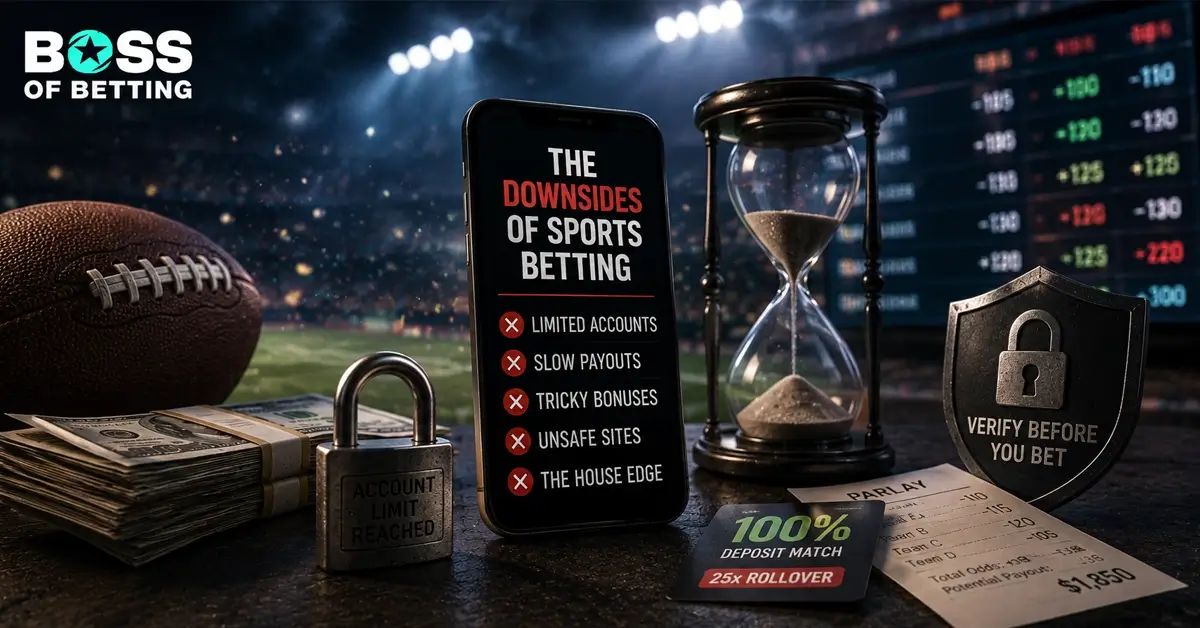
I genuinely enjoy betting on sports. The research, the strategy, the thrill of being right: it’s all part of the appeal. But here’s what most sportsbook ads won’t tell you. Online sports betting has some deeply frustrating habits that can grind you down if you don’t see them coming.
Online sports betting can be safe and worthwhile, but only when you know its worst habits and bet around them.
This is my personal ranking of the things I like least about betting online, paired with how I actually handle each one. No hype, no sales pitch. Just a bettor-to-bettor breakdown of the downsides and what you can do about them.
Key Takeaways
- Many books limit or close accounts that win consistently, so spread your play across several licensed sportsbooks.
- Slow payouts usually trace to KYC verification. Complete it early and pick faster withdrawal methods.
- Welcome bonuses are wagering obligations, not free cash; read the rollover before opting in.
- Unlicensed sites are the real danger. Verify licensing, encryption, and payout reputation before depositing.
- The house edge is real (win roughly 52.4% at -110 to break even), so shop lines, skip high-margin parlays, and bet only what you can afford to lose.
1. Getting Limited Or Banned The Moment You Start Winning
Win consistently and many books will quietly cut your maximum bet or close you out entirely.
This is the frustration that stings the most. You do everything right (research your picks, manage your bankroll, find value) and your reward is a drastically reduced betting limit or a locked account.
At a Massachusetts Gaming Commission roundtable in September 2024, major U.S. sportsbooks including BetMGM, FanDuel, DraftKings, Caesars, Fanatics, and ESPN Bet publicly defended restricting sharp bettors. Operators told regulators the number of limited players is tiny, well under 1% of bettors, framing it as targeting “advantage players” rather than all winners.
Here’s where it gets nuanced. Fanatics said about half of those limited were actually net-losing at the time of the restriction. Operators say they judge how you bet (exploiting line latency, stacking bonuses) rather than purely whether you win. Whether that distinction matters when your account is crippled is another question.
There is some progress on transparency. Massachusetts became the first state to require sportsbooks to formally explain why they restrict profitable accounts, with the rule taking effect June 1, 2026. Operator data in that process showed limits affect roughly 0.64% of accounts, still thousands of bettors.
The fix: Don’t put all your action on one sportsbook. Keep accounts at US books if they are available to you and licensed offshore books to line-shop for the best price. If one book limits you, you still have options. This is exactly why spreading your play across vetted operators matters.
2. Waiting Days To Get My Own Money Out
Deposits are instant, but withdrawals crawl. That asymmetry is by design.
You can fund your account in seconds, but try to cash out and suddenly there’s a queue. Sportsbook payouts can take several business days to clear, and then your chosen payment method adds more time on top of that.
The bottleneck is usually identity verification. If the automated KYC checks pass, you’re through instantly. But a manual review queue of 24 to 72 hours is very common, especially on your first withdrawal or when withdrawing larger amounts. In high-volume periods or enhanced-check cases, you might wait three to seven business days.
KYC isn’t just a roadblock for the same of roadblocking though, it’s a legitimate safety step that protects you from fraud and protects your payout from being sent to the wrong person.
It is friction by design. Getting money out is slow, while putting money in is instant. You can reverse a withdrawal with one click, but getting money out takes patience.
The fix: Complete your identity verification immediately after signup, before you ever need to withdraw. When you do cash out, know your method’s speed. Crypto withdrawals are usually faster than cards or bank wires, but they still go through the same verification. Watch for withdrawal limits and fees that eat into your winnings.
3. “Free” Bonus Money That’s Almost Impossible To Cash Out
That welcome bonus isn’t cash. It’s a wagering obligation with strings attached.
Every sportsbook I review advertises deposit matches and free bets. What they don’t advertise as loudly is the rollover requirement, also called playthrough or wagering requirement. This is the minimum you must wager before you can withdraw bonus-linked funds.
Sportsbook rollovers typically range from 5x to 25x. So, a 100% match maxed at a $1,000 deposit with a 5x rollover means you must place $10,000 in bets within 30 days before you can touch that bonus money.
The trap is straightforward. Cash out before you clear the rollover and you usually forfeit the bonus and anything you won with it. That “free” $1,000 disappears.
Many bonuses also have minimum odds requirements (your -500 favorite won’t count) and game exclusions that limit which bets qualify. Miss any of these conditions and your progress resets or vanishes.
The fix: Look for solid bonuses. Read the rollover multiple, minimum odds, and expiry date before opting into any bonus. An overly generous bonus is often a red flag, not a gift. If the math means you’d have to bet more than you normally would, skip it. A smaller bonus you can actually clear beats a large one you’ll never see.
4. Shady, Unlicensed Sites That Make You The Product
The biggest risk in online betting is handing money to a site that never intended to pay you.
Plenty of sites look professional and promise huge bonuses. But if they’re unlicensed or poorly regulated, your deposit might be the last you see of your money.
Licensing matters, but not all licenses are equal. Regulators like the UK Gambling Commission and the Malta Gaming Authority hold sportsbooks to strict standards. The MGA’s stated objectives include promoting responsible gaming and safeguarding players’ rights so bettors can gamble in a safe and sustainable manner. A cheap Curaçao license, by contrast, comes with far weaker oversight and less credibility.
Beyond licensing, look for concrete security signals. TLS encryption protects your data in transit. KYC verification (the same process that slows withdrawals) also confirms that payouts go to the right person. These are annoyances but they’re also protection.
Red flags include delayed payouts with no clear reason, excessive withdrawal limits that keep your money locked up, hidden processing fees, and unresponsive customer support. A sportsbook’s payout history and reputation tell you more than any marketing copy.
The fix: Before you deposit anywhere, run a short checklist. Is the licensing information transparent and verifiable? Does the site use encryption? What do reviews say about actual payout experiences? Stick to long-standing, well-reviewed books with proven track records. The few minutes of research can save you real money.
5. The Math Is Quietly Working Against You
The vig means you have to be right more than half the time just to break even.
This isn’t a scam, it’s the math that lets books survive, but something you should know. At standard -110 odds, you must win 52.38% of your bets to break even. Below that, you lose over time, guaranteed.
The aggregate numbers show exactly how this plays out. In 2024 alone, Americans bet nearly $150 billion legally, and the books kept a record 9.3% of it. That’s the house edge working exactly as designed.
What’s concerning is that it’s getting harder. The national hold keeps climbing as more bettors pile into high-margin parlays and same-game parlays. These bets are fun, but they carry significantly worse odds for the bettor. The more legs you add, the more the house edge compounds against you.
The fix: Shop for the best line across multiple books. Even a half-point matters over time. Be skeptical of high-margin parlays, especially the “boosts” that still favor the house. Track your betting bankroll so you actually know your win rate instead of guessing. And accept that long-term profit requires discipline, not luck.
6. How Easy It Is To Lose Control
The same 24/7 convenience that makes online betting fun makes it easy to bet more than you planned.
The app is always in your pocket. There’s always another game, another line, another chance to chase a loss. That accessibility is a feature for casual entertainment and a genuine risk for anyone prone to compulsive behavior.
According to the National Council on Problem Gambling, nearly 20 million U.S. adults reported at least one problematic gambling behavior “many times.” This is a behavioral indicator count, not a clinical diagnosis, but it signals real risk. A smaller share meet the threshold for a clinical gambling disorder.
Sports bettors face elevated risk. Research shows the rate of gambling problems among sports bettors is at least twice that of other gamblers. That said, researchers have not reached consensus: separate research from Wofford College found no significant widespread financial harm, with effects concentrated among young, low-income men.
The fix: Set deposit limits and time limits using your sportsbook’s responsible gambling tools. Most licensed books offer them. Never chase losses; that’s how small problems become big ones. Bet only with money you’ve decided in advance you can afford to lose.
If gambling stops feeling like entertainment, reach out. The National Problem Gambling Helpline is available 24/7: 1-800-GAMBLER. I also have a guide on preventing betting addiction with helpful tactics to slow down and stop.
Tips For Betting Online Without The Headaches
These fixes work together. Here’s the short version:
- Verify your identity right after signup. Don’t wait until your first withdrawal to discover you’re stuck in a review queue.
- Read every bonus’s rollover, minimum odds, and expiry before opting in. If the terms make the bonus impractical, skip it.
- Keep accounts at several licensed books and shop the best line. This protects you from limits and gets you better prices.
- Confirm licensing, encryption, and payout reputation before depositing. A few minutes of due diligence beats losing your bankroll to a shady operator.
- Set deposit and time limits, and never chase losses. The point is entertainment, not desperation.
Conclusion
My gripes are real. Winner limits, slow payouts, bonus strings, shady sites, the house edge, and the risk of losing control: these are baked into online sports betting. Ignoring them doesn’t make them go away.
Knowing the downsides is the first step to betting smarter.
You can’t remove the house edge, but you can refuse to make it worse. Bet at vetted books, on your terms, with money you can afford to lose.
That’s the honest take. Online sports betting can be worth your time if you go in clear-eyed, do your research, and stay disciplined. Just don’t let the marketing convince you it’s something it isn’t.
Frequently Asked Questions
Why Do Sportsbooks Limit Or Ban Winning Bettors?
Because consistent winners cut into their margin. Sportsbooks say they target betting patterns (like line exploitation or bonus abuse) rather than results alone, but the practical effect is that sharp bettors often find their accounts restricted.
Why Are Online Sportsbook Withdrawals So Slow?
Withdrawals trigger manual KYC and identity verification that often takes 24 to 72 hours, while deposits clear instantly by design. Completing verification early and choosing faster methods like crypto can reduce the wait.
Why Can’t I Cash Out My Sportsbook Bonus?
Because bonuses carry rollover requirements, often 5x to 25x, that you must wager through before withdrawing. Cash out early and you typically forfeit the bonus and any winnings tied to it.
Is Online Sports Betting Legal In The U.S.?
Online sports betting is now legal in many U.S. states. Many offshore books also accept US players, but the rules vary widely, so check your state before signing up.
Is Online Sports Betting Addictive?
It can be. As covered above, sports bettors report gambling problems at a notably higher rate than other gamblers, so set deposit and time limits, use responsible gambling tools, and reach out to 1-800-GAMBLER if betting stops feeling like entertainment.
About the Author

Alonzo Solano
The Boss of Betting, Editor-in-Chief & Sports Analyst
Alonzo Solano is an author, sports analyst, Editor in Chief of BossofBetting.com, and host of the 'NFL Latino TV' podcast.
Outside of family, his biggest passion is NFL football. Perhaps he is best known for his podcast 'NFL Latino TV,' where he shares his analysis and perspectives on the game with a worldwide Spanish-speaking audience.
Previous post

Is the U.S. About to Crack Down on Offshore Betting? What Bettors Need to Know
Alonzo Solano | July 20, 2026Next post